Innovation
NCCTRC provides emergency ration pack to personnel during training exercises and deployments. NCCTRC has set a minimum nutritional standard requirement to maintain its packs quality and to ensure that the packs are ideal to supply for its members.
Compliant with daily calorie (cal Dietary Intake(DI) recommendations for moderate work and average BMI for Men, 3000 cal, and for Women, 2000 cal, according to Nutrient Reference Values for Australia and New Zealand standards. There are 6 Ration pack varieties that range between approximately 2,648 cal – 3,283 calories. Also included in the packs are environmentally sustainable cutlery products.
All our meal packs meet daily nutritional intake requirement standards
[wp_colorbox_media url="https://www.youtube.com/watch?v=NraHW6vDQe0" type="youtube" hyperlink="YOUTUBE"]
AUSMAT units are expected to be self-sufficient in the field for water supplies with requirements dependent upon level of deployment. Potable water requirement to an EMT varies with scale, complexity and EMT configuration. A principal operational goal of AUSMAT is development of a safe, in-country water supply within twenty four hours of deployment.
Water supplies are considered contaminated unless guaranteed and monitored to meet quality objectives. In-country logistics planning makes allowance for a strategic, secure location for water supply, treatment and distribution equipment as a dedicated part of the AUSMAT medical facility. Bottled water is not an ongoing option for large scale deployments it is included as a risk management strategy in the event water quality is compromised.
NCCTRC recognises the cluster approach: often other aid agencies are engaged to provide source water and technical assistance through a WASH cluster arrangement.
AUSMAT DEPLOYMENTS HAVE CAPACITY TO INCLUDE THE FOLLOWING WATER TREATMENT PROCESSES:
- Particle filtration
- Membrane filtration
- Reverse osmosis
- Activated Carbon Filtration
- pH adjustment
- Coagulation/flocculation
- UV Treatment
All water must undergo ultraviolet and chlorine disinfection prior to reticulation regardless of previous water treatment techniques.
The uplift program is a virtual checklist developed for the NCCTRC that has reduced manual handling and any chance of human error by placing all information on stock, supply and resources down to one point of reference.
The program allows system alerts, scheduling, resupply and deployment requirements to be available immediately on request.
The system is accessible remotely and is shareable as required. For example, the entire manifest for a deployment can be sent to the RAAF within minutes allowing loadmasters to know the exact number, dimensions and weight of items needing to be deployed.
Stretcher frame system
The Stretcher Frame System is an equipped patient transport bus that our logisticians engineered in collaboration with Buslink. It is an everyday special needs bus which can be converted in less than 30 minutes to a multi-casualty patient transport vehicle. It forms part of the response capability that our medical team deploys.
TrackMi
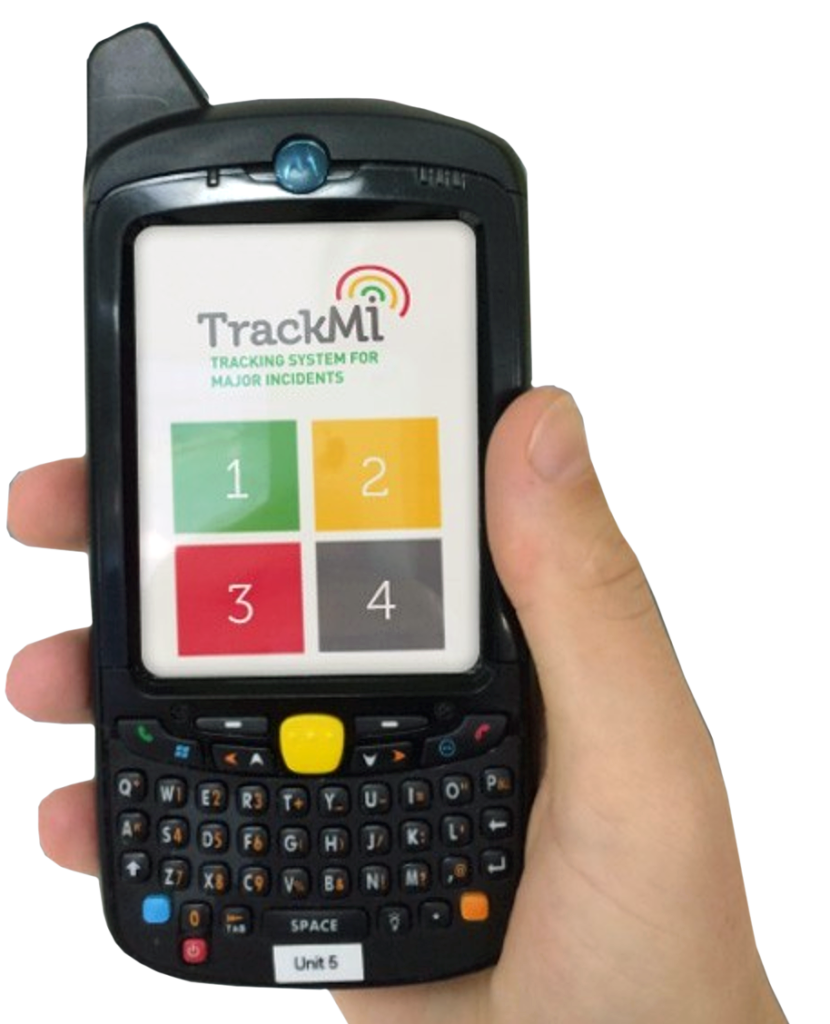
TrackMi, developed by the National Critical Care and Trauma Response Centre and funded by the Federal Attorney-General's office since 2010, was originally developed to track patients in a disaster zone to allow for early medical resource allocation.
TrackMi has many other uses beyond tracking patients, one of which is to monitor movements of people during cyclone evacuations and the recovery phase.
The device uses similar technology to supermarket tracking systems. A person wears a simple wristband with a bar code, the bar code is scanned using a handheld device, assigned to a flight for evacuation and the information is logged into TrackMi including the time, flight number and time of departure. The technology has been used to help manage the catering resources for evacuees at Camp Elcho in Galiwinku.
The NCCTRC has shared the technology with every state and territory and it has proved so cost-effective and efficient in trials that it has attracted international interest.