Travel smart, travel safe: essential health advice for deployment
24 Sep 2025
Written by Dr Bhavya Balasubramanya
Travel health preparedness means taking proactive steps to protect health and well-being while being away. These include pre-travel medical consultations, recommended vaccinations, preventive medications (chemoprophylaxis), a first aid kit, awareness of destination-specific health risks and comprehensive health insurance.
This preventative approach is a key part of deployment readiness for AUSMAT members, whether nationally or internationally.
Figure 1
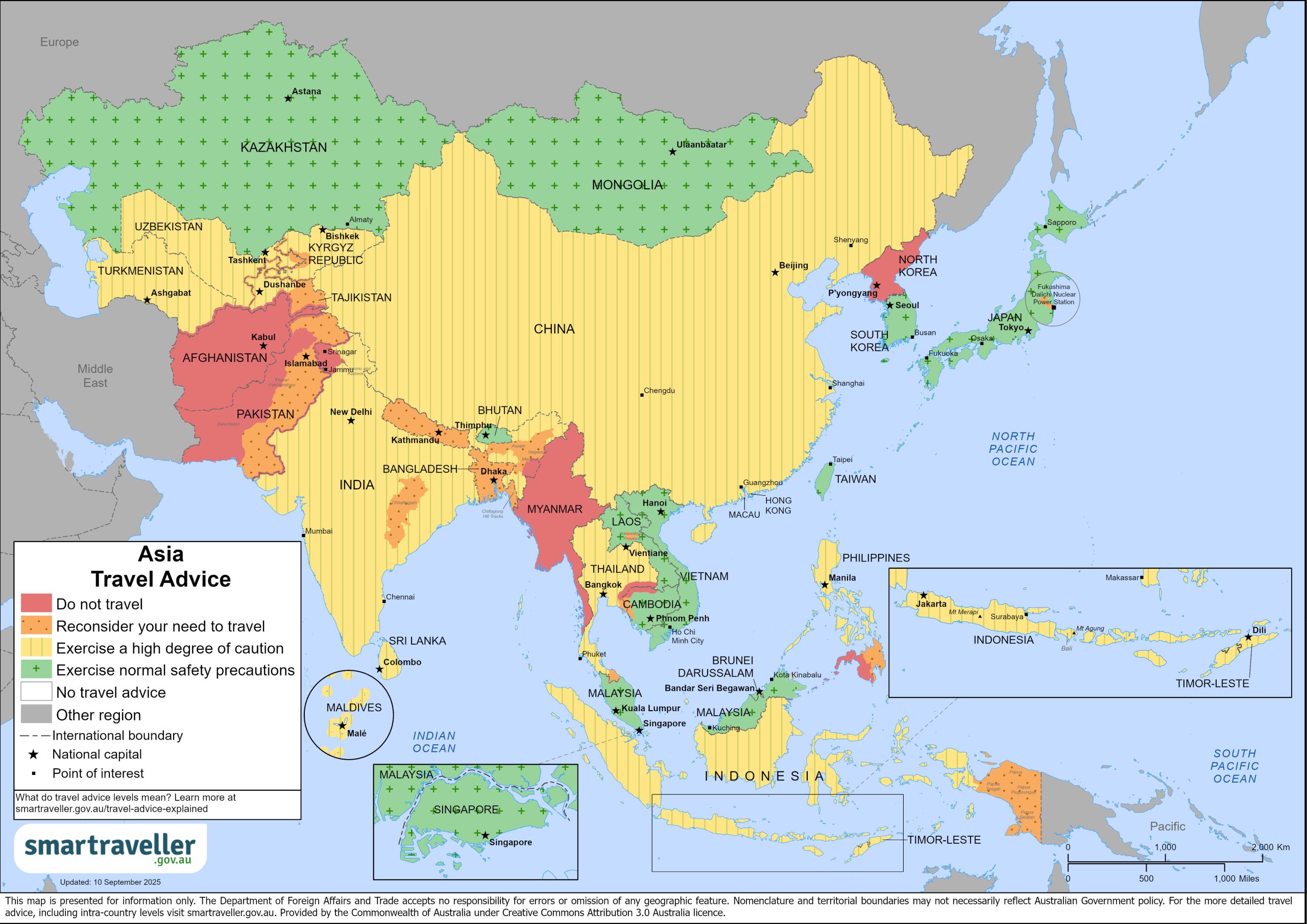
Figure 2
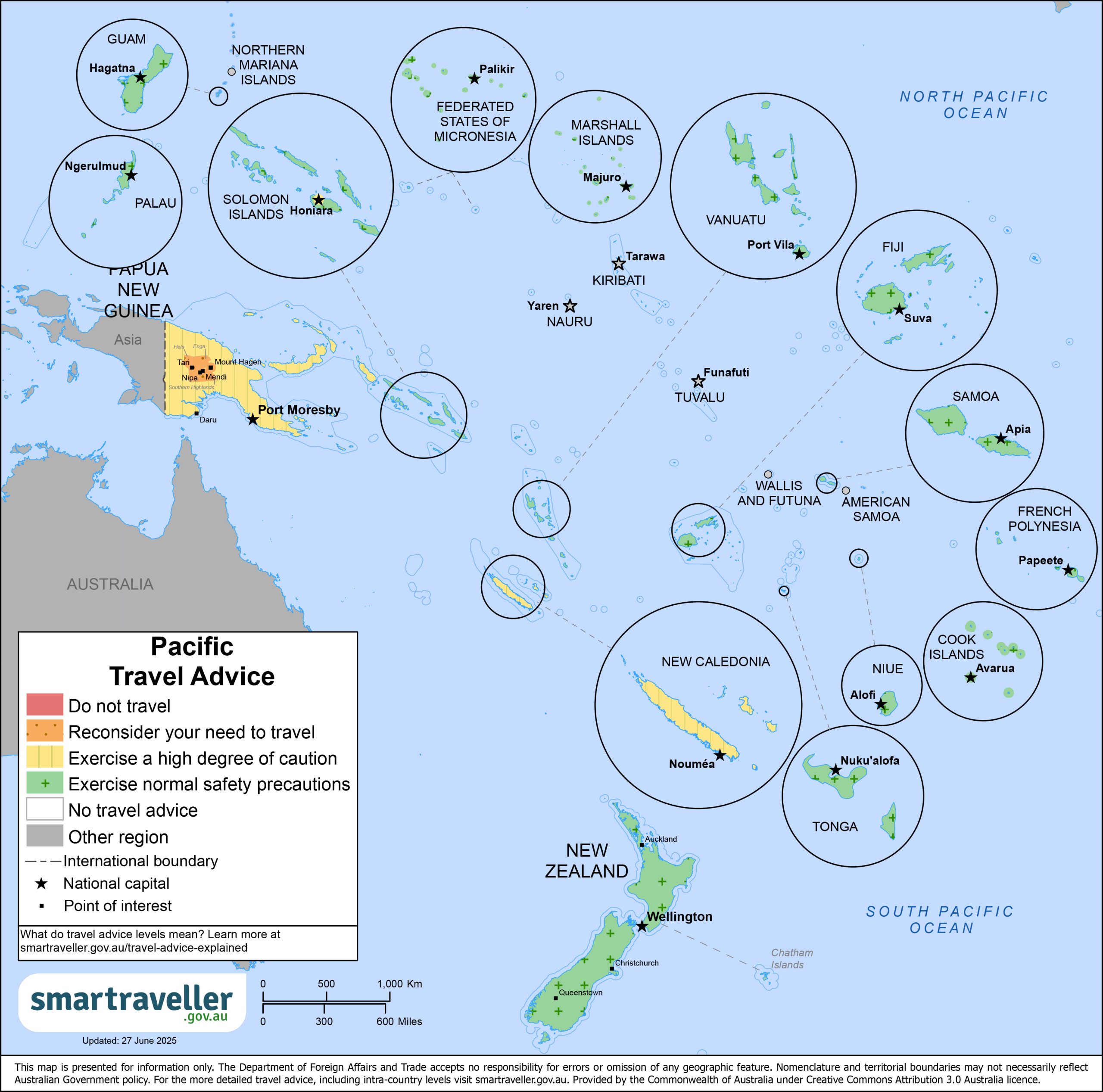
Figures 1 and 2: Travel advice for the Asia-Pacific region, showing Australian Government advice levels from ‘exercise normal safety precautions’ (green) to ‘do not travel’ (red). Source: Australian Government Department of Foreign Affairs and Trade – Smartraveller.
Travel health advice
- Book a pre-travel consultation with a doctor.
- Carry a sufficient supply of medications, along with current prescriptions or letter from your doctor.
- Ensure routine immunisations are up-to-date under the National Immunisation Program.
- Discuss additional vaccines and chemoprophylaxis recommended for the destination.
- Pack a first aid kit, including relevant over-the-counter medications.
- Wear a medical alert bracelet if applicable.
- Arrange a dental examination if access may be limited during travel.
- Carry relevant medical documents, including electronic copies on a secure device.
- Have comprehensive travel health insurance, covering the full duration of travel.
- Review destination-specific advice on Smartraveller, including:
- Remoteness
- Access to and quality of medical care
- Hygiene conditions
- Risk of infectious diseases
- Seasonal weather conditions
- Consider how planned activities may affect your health and what you can safely do.
- Plan transport requirements and protection, e.g. compression stockings for long-haul flights to prevent thrombosis
- Pack hand sanitiser, sun protection, insect repellent, and face masks.
- Keep key documents accessible, with digital backups, including your vaccination record, malaria prophylaxis record, travel health insurance certificate, allergy information and medical letter for prescription medicines.
- Continue to take medications for chronic health conditions.
- Avoid risk-taking behaviours such as excessive alcohol use, recreational drug use, risky sexual contact, approaching animals or entering unsafe environments.
- Practise safe behaviours: road safety, food and water hygiene, protection from insects and extreme weather.
Some infections may develop after returning home. Seek medical attention if you:
- Become ill in the weeks following travel, particularly with:
- Fever
- Flu-like symptoms (headache, cough, cold, joint or muscle aches
- Persistent diarrhoea or vomiting
- Jaundice (yellowing of skin or eyes)
- Urinary or genital symptoms
- Skin disease
- Received treatment for malaria while travelling
- May have been exposed to an infectious disease, including STIs, even in the absence of symptoms
- Experience worsening of an existing health condition.
Are you fit to travel as an AUSMAT member?
Prior to deployment, AUSMAT members undergo pre-travel health and fitness checks, including a health survey covering allergies and details regarding malaria prophylaxis.
AUSMAT pre- travel health and fitness checks
AUSMAT members are offered both routine and extended immunisations under the National Immunisation Program and chemoprophylaxis to protect against communicable disease threats prior to deployment.
| Vaccination | Recommended Dosing Information | Evidence | Booster Timing |
|---|---|---|---|
| COVID-19 | Up to date in accordance with most recent ATAGI guidance | Evidence of administration | According to age and risk profile |
| Diphtheria/Tetanus/Pertussis | Single Injection | Evidence of administration | 5 yearly |
| Hepatitis A | Two dose schedule greater than six months apart (monovalent vaccine). If combination with Hepatitis B, follow Hepatitis B advice.2 | Evidence of 2 doses greater than 6 months apart or serological proof of immunity | Lifelong |
| Hepatitis B | Three dose schedule (day 0, 30, 180) plus serological proof of immunity | Serological proof of immunity | Lifelong |
| Influenza | Single Injection | Evidence of Administration | Yearly |
| Measles/ Mumps/ Rubella | Two dose schedule (day 0, 30) | Evidence of administration or serological proof of immunity of all three diseases | Lifelong |
| Varicella | Two dose schedule (day 0, 30) | Evidence of Administration or Serological Proof of Immunity | Lifelong |
Figure 1: Baseline immunisation. Australian Government Department of Health, Disability and Ageing
| Vaccination | Recommended Dosing Information | Evidence | Booster Timing |
|---|---|---|---|
| Cholera | Dukoral® - 2 dose course completed with 1-6 weeks between doses (if greater than 6 weeks, need to repeat) Boosters within 2 years of last dose (if not, repeat 2 dose course) (preferred) Vaxchora® - single dose (immunocompetent only) | Dukoral® Evidence of 2 dose course and single booster dose within 2 years of last dose Vaxchora – Evidence of administration | Dukoral® - 2 Yearly Vaxchora® - 6 months until further notice, coverage unknown beyond 3-6 months |
| Japanese Encephalitis | Imojev ® Single Injection (Immunocompetent) JEspect® 3 dose schedule (day 0, 30, 365) (Immunocompromised) | Evidence of administration | 5 yearly (Imojev®) 2 yearly (JEspect®) |
| Poliomyelitis | Single Injection | Evidence of Administration | 10 Yearly |
| Rabies | 3 dose course (day 0, 7, 365) (Immunocompetent) OR 4 dose course (day 0, 7, 21-28, 365) (Immunocompromised) OR serological proof of immunity (level >0.5IU/mL) | Evidence of Administration | Nil |
| Typhoid | Single Injection OR Oral capsules on alternate days for 3 or 4 doses | Evidence of Administration | 3 Yearly (injection or oral 3 dose) OR 5 Yearly (oral 4 dose) |
Figure 2: Extended immunisations (pre-travel). Australian Government Department of Health, Disability and Ageing
References
- Australian Government Department of Health, Disability and Ageing. 2025. The Australian Immunisation Handbook.
- Health Direct. 2024. Travel health advice.
- Mills DJ, Ramsey L, Furuya-Kanamori, L. 2021. Pre- and Post-Travel Medical Consultations in Tourist Health, Safety and Wellbeing in the New Normal 47-69. https://doi.org/10.1007/978-981-16-5415-2
- United States Centres for Disease Control and Prevention. 2022. Travelers' Health.
- World Health Organization. 2024. International travel and health – Module 1: General health risks and considerations for travellers.